Cargando…
Cargando…
Cargando…
Cargando…Cargando…
Cargando…The first thing worth understanding is what kind of product this is, because it defines everything else. This isn't an apartment or a finished house: it's a residential lot inside a gated community of 10 hectares in Playa del Carmen, with 310 single-family lots. The distinction matters. When you buy land instead of a built unit, you don't inherit someone else's decisions —the finishes, the layout, the style—, you buy the space to make your own. You build the home your family needs.
It's worth being clear from the start about something many sellers leave out: buying the lot and being able to build don't happen on the same day. This is a presale development, with a construction timeline. Deeding is projected for late 2026, and construction in the first stage can begin around September 2027, once the developer delivers services and access roads. The second stage starts construction later, toward the end of 2029. I say this plainly because if what you need is to build right away, this isn't the product. If instead you're looking to lock in a location and a presale price today in order to build over the coming years, the logic fits.
The development is divided into two stages, and they aren't identical. The first holds 113 lots, with sizes ranging from 148.42 to 197.51 m². The second concentrates 197 lots, with a wider range: from 127.14 up to 280.74 m². Together the two stages add up to 310 lots, connected by a 900-meter walkway that runs through the development and links them. That range of sizes isn't a technical detail, it defines who each lot is for: the 127 m² end works for a first home or a compact footprint; the 280 m² end leaves room for a larger project. The honest recommendation is to choose the size based on the project you have in mind, not the other way around.
On infrastructure, here's what the developer confirms in its data sheet. The community will have potable water, sanitary drainage, a wastewater treatment plant, and storm drainage with absorption wells. Add to that electrical supply at the edge of each lot, lighting on roads and common areas, wide interior concrete streets, a perimeter wall, an administrative office, and an underground voice and data system. These services are delivered according to each stage's construction schedule, not from day one —a point worth keeping in mind when planning your build.
Security is handled in three layers: a 24-hour guardhouse with access gates, closed-circuit surveillance, and a perimeter wall, with controlled access for guests and suppliers. For a gated residential community built around living peacefully, that isn't a luxury, it's the baseline. A couple of rules worth mentioning define the character of the place: each lot is single-family —one home per lot, with no option to subdivide or legally merge lots— and the development operates under a condominium regime, with building regulations and an architecture committee that reviews each project. That protects the coherence of the setting: your neighbor can't put up something that breaks the whole, and neither can you.
Playa del Carmen is the center of gravity of the Riviera Maya, and that has a practical consequence for anyone buying here: you're not betting that the area will develop, you're buying into an established city that keeps growing. The difference with more remote developments —deep in the jungle, waiting for infrastructure to arrive— is that here urban life already exists around you.
The location figures are concrete. The development is 4.2 km from the beach and 2 km from the Cancun-Tulum Federal Highway, on Av. Universidades, one of the city's consolidating corridors. That proximity to the highway is what connects the lot to the rest of the Riviera Maya: the airport, Cancun to the north, Tulum to the south. You're not isolated; you're at a point with quick access in both directions.
The land is zoned for residential use, with a land occupancy coefficient (C.O.S.) of 0.55 and a land use coefficient (C.U.S.) of 1.60. In practical terms, that defines how much of your lot you can cover at ground level and how much total construction you can build —a figure your architect will appreciate having from the start, because it frames what's possible to build.
A clarification is in order here, to avoid confusion. The overall project also includes a separate offering of mixed-use land, geared toward commercial uses. Those lots are a different product, with different conditions, and they are not part of the residential community. I mention it because the existence of that mixed-use zone suggests the surroundings have potential for nearby services and commerce in the future —schools, shops, restaurants. But that potential is an argument about the area, not a promise about your residential lot. Keeping that line clear is part of speaking to you honestly.
For a family, the translation is direct: living in an area with quick access to the city and the beach, where services may settle nearby over time, without giving up the secured character of your community. For anyone weighing the investment component, the logic is the same from another angle: areas that combine an established residential core with development around them tend to hold their value better. That's not a guarantee —no future movement in value ever is—, it's the reason location weighs so heavily in this decision.
The phrase "beach life" gets used so much that it no longer means anything, so it's worth grounding it in what it actually means here.
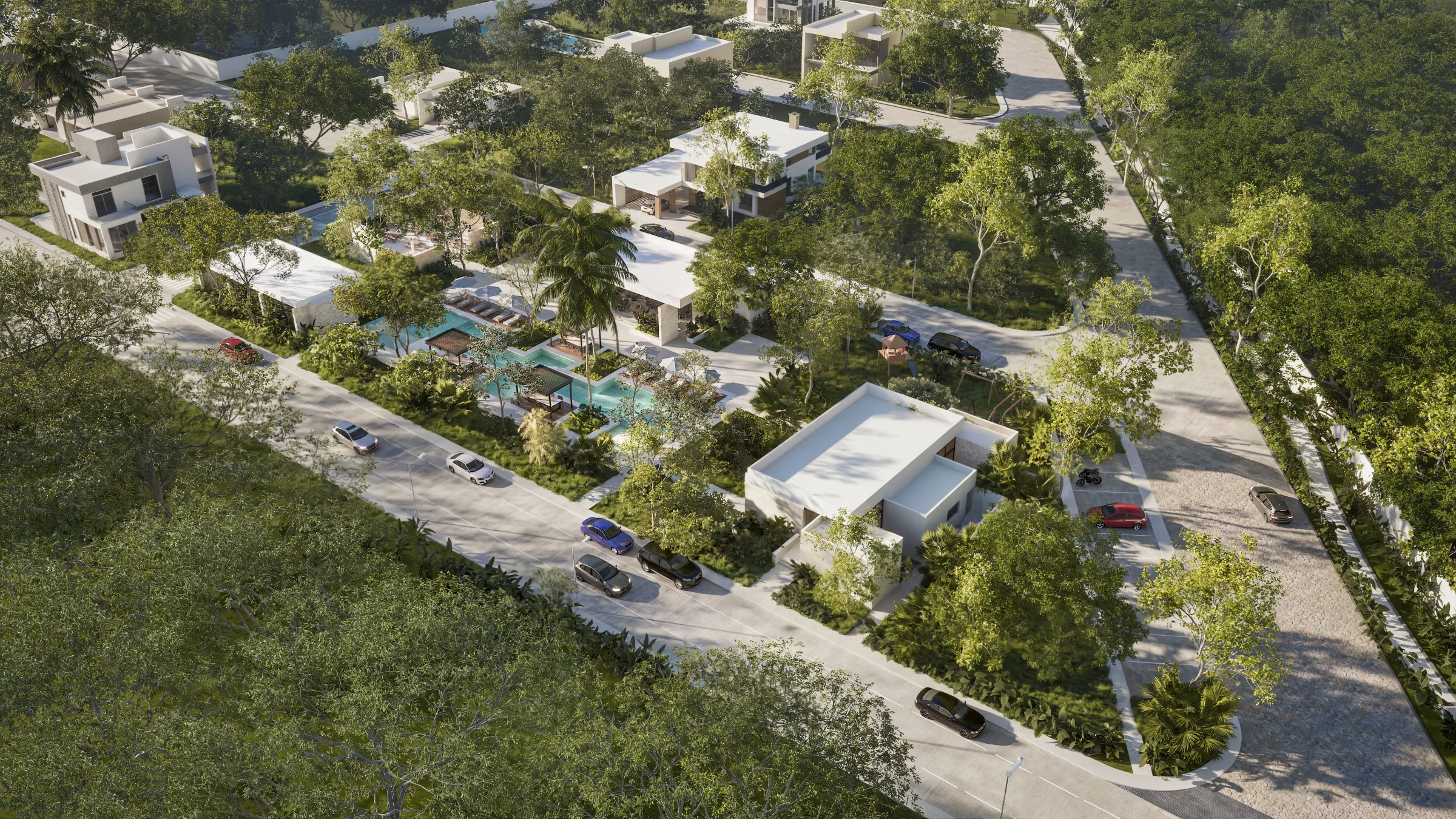
It means the amenities are the center of the design, not an add-on. The community includes a pool with sun decks and individual pergolas, an enclosed gym, an event hall, a barbecue and picnic area, a terrace with a bar, padel and pickleball courts, a multipurpose court, a playground, a social area with restrooms, a dog park, and green areas connected by walkways. As with the infrastructure, these amenities are delivered according to each stage's construction schedule —it's worth reviewing the estimated dates with your advisor.
What's interesting is what that list implies for a family. A dog park means the dog is part of the plan. An event hall means birthdays and gatherings happen inside the community, in a secure setting. The padel and pickleball courts mean keeping an active routine doesn't require leaving or paying for another membership. Added up, what's being designed isn't a list of facilities, it's a way for daily life to happen mostly within a cared-for environment.
And here it matters again that this is land. The lifestyle isn't delivered prepackaged: you build it. You choose when to build —within the regulation's timeframes—, what kind of house, at what pace. For many families that's precisely the advantage: securing the location, the presale price and the amenities today, and building the house when timing and budget allow. It's worth knowing that the development sets a maximum five-year window to begin construction, with clear rules —it's a framework, not a restriction that surprises you later, as long as you know it up front.
Direct financing with the developer aligns with that buy-now, build-later logic. The published conditions include a down payment from 20% and interest-free financing: up to 48 months in the first stage and up to 60 months in the second, in both cases with a final payment. Those who pay in cash get a 10% discount. Price varies by stage, size and payment method: the price per m² starts from $7,200 MXN financed (and from $6,480 MXN in cash), which places the most accessible lots from around $998,000 MXN. These are real conditions, published by the developer, subject to change and availability —worth confirming the current terms and the specific lot at the time you decide. There's also an estimated monthly maintenance fee, between $1,500 and $2,500 MXN, to be defined closer to delivery.
If I had to sum up who it's for and who it isn't: this development makes sense if you're looking to secure an established location in Playa del Carmen, at a presale price, inside a gated community with real security and amenities, and to build at your own pace over the coming years. If you need to move into a finished house soon, it isn't your product —and it's better to say so now. The natural next step, if it fits, is to review lot availability and the payment plans with an advisor.
Have a different question? Our advisors respond in under 5 minutes via WhatsApp.
The reference price is calculated using the Banxico exchange rate. The final price depends on the exchange rate agreed upon in the negotiation.
Get availability, plans and pricing from our advisors — under 5 minutes.